Why Mexicans Call You 'Fat' (And Why It's a Compliment)
In Canada, calling someone fat is a hate crime.
In Mexico, it's how your tía shows she loves you.
I'm not joking. The first time a Mexican woman I'd known for forty seconds called me "gordito," I assumed I was about to be in a fight. I was not. I was about to be hugged.
After two years in the Yucatán, I've stopped flinching. I've also gained four kilos. So gordito is, increasingly, accurate. That's also fine.
This is one of the bigger gaps between Anglo and Mexican cultures, and it shows up in language first. Here is the field guide.
The cast of nicknames
Walk into any Mexican market, restaurant, or family gathering and these are the words you will hear used as terms of endearment, almost certainly aimed at someone, almost certainly affectionately:
- Gordito / gordita (little fat one). Universal. Said by aunts, grandmothers, partners, sometimes strangers.
- Flaco / flaca (skinny one). Same energy. A man at the corner store will call a woman he's known for two minutes flaca and mean nothing other than "I'm being friendly."
- Güero / güera (light-skinned). Used by taco vendors, market sellers, taxi drivers. Doesn't actually require you to be light-skinned. It's a "hey friendly stranger" word.
- Negrito / negrita (dark-skinned). Used inside families and close friendships. The context matters here, and we'll come back to this one.
- Chaparrito / chaparrita (short one). Used affectionately for kids and partners.
- Viejo / vieja (old man, old woman). When a Mexican woman calls her husband viejo, she means my person. Not "elderly."
- Mi reina / mi rey (my queen, my king). Said by older women to younger ones, by partners to each other, by strangers in the right register.
If you grew up in an Anglo culture, this list is approximately one paragraph long and reads like a manual for harassment. In Mexico, it's just affection.
What is happening here?
The grammar trick
The mechanic is the diminutive.
In Spanish, adding -ito or -ita to a word makes it grammatically smaller. Gato (cat) becomes gatito (kitten). Casa (house) becomes casita (small house).
In Mexican Spanish, the diminutive doesn't shrink the meaning. It warms it.
- Favor is a request. Favorcito is asking gently, between friends.
- Café is coffee. Cafecito is "let's sit down for a minute."
- Gordo describes a body. Gordito describes someone you love.
The same suffix that turns a kitten into a smaller cat turns a body description into a term of affection. The body is not the topic. The intimacy is the topic.
Mexican Spanish doesn't avoid the body. It just refuses to use the body as a weapon.
The Anglo problem
I've watched American visitors flinch when their Mexican host calls them gordito. I've watched Canadian tourists correct a Mexican waiter who called them güerito. Both reactions are the same mistake.
In Anglo cultures, the body is a minefield. You don't comment on it. You don't acknowledge it. The polite move is to pretend the body isn't there.
In Mexican culture, the body is just here. It has a shape. It has a color. It has a nickname. The nickname is affectionate by default.
The Anglo move is to lie about the body. "You look great!" (Meaning: I am refusing to engage.) The Mexican move is to love the body. "¡Cómo está mi gordito!" (Meaning: I am engaging fully.)
I lived in London for years. I lived in Toronto. I know exactly how heavy the Anglo silence around bodies is. And I know exactly how much energy goes into not noticing things.
Mexico doesn't spend any of that energy. And honestly? After two years here, my body and I feel less surveilled than we ever did in Canada.
The one nickname you should not accept
The diminutive is not magic. It does not save every word.
Two rules:
1. The diminutive warms a word that was already neutral or positive. Gordo is neutral. Gordito is warm. Flaco is neutral. Flaco is warm. Güero is neutral. Güerito is friendlier.
2. The diminutive sharpens a word that was already negative. If someone calls you pendejo (idiot), they mean it. If they call you pendejito, it's worse. Now there is sarcasm in it. If someone calls you naco (a class insult), the diminutive naquito does not save it. It scales the insult.
The rule is:
Warm word + diminutive = more love. Mean word + diminutive = more mean.
If a Mexican woman in a market calls you gordito, relax. She likes you. If a guy in a bar calls you pendejito, leave the bar.
That's the whole code.
A note on negrito and the rest
I want to be careful here, because this is the place where Anglo brains short-circuit hardest.
Negrito and negrita are used affectionately inside Mexican families, often referring to skin tone, often as terms of love between partners and parents and grandparents. In Mexican context, this is not an insult and not racially charged the way it sounds when translated literally to English.
It is also not your word to use as a foreigner.
The rule of thumb that has served me well in two years here:
Affectionate descriptive nicknames are received by foreigners with grace. They are not given by foreigners, especially in cross-cultural registers.
If a Mexican grandmother calls you güero with affection, accept it. Smile. Don't correct her. Don't tell her you find it problematic.
If you're a foreigner, lead with the safer nicknames. Mi amor. Mi reina. Corazón. These travel cleanly. They cost you nothing. They make Mexicans warm faster than anything you'll learn in a Spanish class.
What it looks like when you've gotten this right
A few weeks ago a Mexican friend of mine introduced me to her abuela. The grandmother looked me up and down, smiled, and said:
"Mira, qué güerito tan flaquito."
Translation: "Look, what a little blond skinny one."
Six countries ago, I would have flinched. Today, I smiled back and said:
"Gracias, doña, qué amable."
She patted my arm. Took it as a compliment. Offered me food.
Mexican Spanish has a feature most languages don't: the body is welcome at the table. Your aunt can call you fat. Your neighbor can call you skinny. The taco guy can call you blondie. Everyone is loved. Nobody is lying.
After 6 cities and 5 languages I was bad at, this is the one I'm trying hardest to learn. Not the grammar. The warmth.
The grammar I can get from any textbook. The warmth, you have to be in the room for.
30-second version of this is on the channel: Why Mexicans Call People "Fat". The full deep-dive long-form episode is up too: "Why Mexicans Call You Fat (And Why It's a Compliment)."
The app for real Mexican Spanish: PalabraFlow.
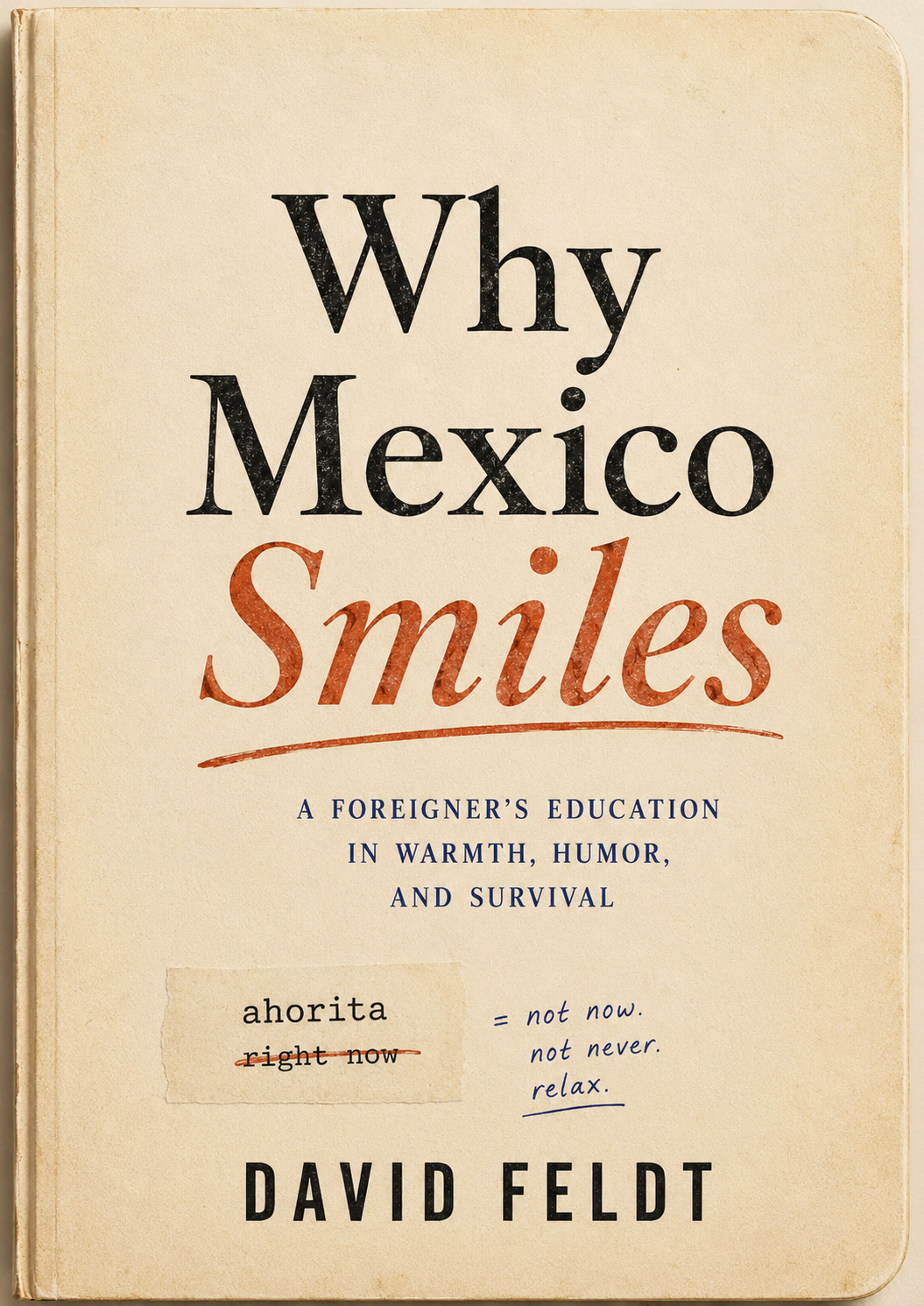
Why Mexico Smiles
A Foreigner's Education in Warmth, Humor, and Survival
A foreigner comes to Mexico to learn a language and instead learns why Mexicans are the way they are. Read Chapter 1 free, or take home the whole thing.

PalabraFlow
Your conversation operating system for Mexico
40 real-life situations, practiced out loud with an AI tutor that talks back in Mexican Spanish and scores how you sound. Stop translating, start answering.