What 'Pásele' Really Means in Mexico (And Why Spanish Class Never Taught It)
I lived in London for three years before anyone ever said "after you" to me. By the time I got to Mexico City, I'd been told pásele fifteen times in a single afternoon, and I still wasn't sure what it meant.
Six countries in. I keep finding words like this. Words that one culture treats as a thousand small social transactions, and another culture has never thought about.
Pásele is Mexico's.
The textbook version
If you crack open any Spanish textbook, you will find pasar defined as "to pass." Pásele is the polite imperative form: "please pass" or "pass through."
Technically correct. Spectacularly incomplete.
What Spanish class will never tell you is that pásele is the single most-used social-glue word in Mexican Spanish. It is to Mexico what cheers is to England. It is to Mérida what aloha is to Hawaii. Used a hundred ways a day, by everyone, and almost never about actually passing anything.
The twelve uses I've personally collected
Here are the contexts I've actually heard pásele in, in the two years I've been paying attention.
- Welcoming you into a home. You knock, the door opens, the host gestures: "Pásele." Translation: come in.
- Welcoming you into a shop. You walk up to the doorway of a small business. The owner sees you hesitate. "Pásele, pásele." Translation: don't hover, come in.
- At a taco stand, when it's your turn. "¡Pásele, jefe! ¿Qué le sirvo?" Translation: I'm ready, what'll you have.
- Letting you go first in line. You both reach for the same thing. They wave you forward. "Pásele." Translation: after you.
- Handing you the receipt or the bag. "Aquí está. Pásele." Translation: here, take it.
- Inviting you to sit down. You walk into a meeting room, someone gestures at the chair. "Pásele, siéntese." Translation: please, sit.
- Inviting you to go ahead and order. "Pásele, dígame." Translation: go ahead, tell me what you want.
- Accepting a request you weren't sure they'd accept. "¿Me lo presta tantito?" "Sí, pásele." Translation: sure, here.
- Closing a transaction politely. You hand them money. They hand back change. "Pásele, que le vaya bien." Translation: there you go, take care.
- Encouraging you to keep going through a story. You're explaining something, you pause. "Pásele, pásele, le escucho." Translation: go on, I'm listening.
- A general "please" or "go ahead" with no specific object. Almost a verbal nod.
- Sometimes, very rarely, actually about passing something physical. This is the textbook version. It is also the rarest.
The cultural mechanic
So what is happening here?
Pásele is not really a verb. It's a register. It marks the space between two people as warm, polite, open, and ready for something to happen.
In English, we have to use about six different phrases to cover the same range. Come in. After you. Go ahead. Here you go. Sit down. Take this. Each one is specific to its action.
Mexican Spanish does it with one word. The word is pásele.
You're not telling the other person to do something. You're telling them: the social moment is open. Proceed.
It's the verbal version of holding the door.
Why no Spanish class teaches this
Two reasons.
First, pásele doesn't follow grammar rules cleanly. It's an imperative of pasar but it's used in contexts where nothing is being passed. Textbooks like clean rules. Pásele is a vibe.
Second, and more importantly: Spanish classes teach you to say things. Mexican Spanish requires you to manage social space. The textbook universe is transactional. The Mexican universe is relational. These two universes overlap in vocabulary and almost nowhere else.
After six countries, I've found that every culture has a word like this. The British have cheers (which means thank you, also goodbye, also yes please, also no thank you depending on tone). The French have voilà (which means here it is, also okay, also there you go, also fine). The Mexicans have pásele.
The thing they all have in common is that no language class ever teaches them. You have to be in the room.
What to do with it
Three rules for using pásele yourself, in increasing order of difficulty.
1. Use it at doors. If you're holding a door, a chair, a turn in line, an elevator: "Pásele." This is the entry-level use. You will get smiles back.
2. Use it when handing something over. Money, a receipt, a glass of water, the salt. "Aquí. Pásele." You will sound less like a tourist than 90% of foreigners after one day.
3. Use it when accepting something. Someone asks you for a favor or to borrow something. Instead of "sí, claro," try "sí, pásele." Now you sound like someone who's been around.
Don't use it when you're nervous, or as a substitute for please. It's not a please in the begging-for-something sense. It's a please in the the door is open, walk through sense.
If you get the register wrong, nobody will correct you. They'll just smile a little more carefully. Which is, of course, the entire Mexican experience.
30-second version of this is on the channel: What "Pásele" Really Means in Mexico.
The app for real Mexican Spanish, including the 50 most-useful Mexican-specific phrases your Spanish class never taught: PalabraFlow.
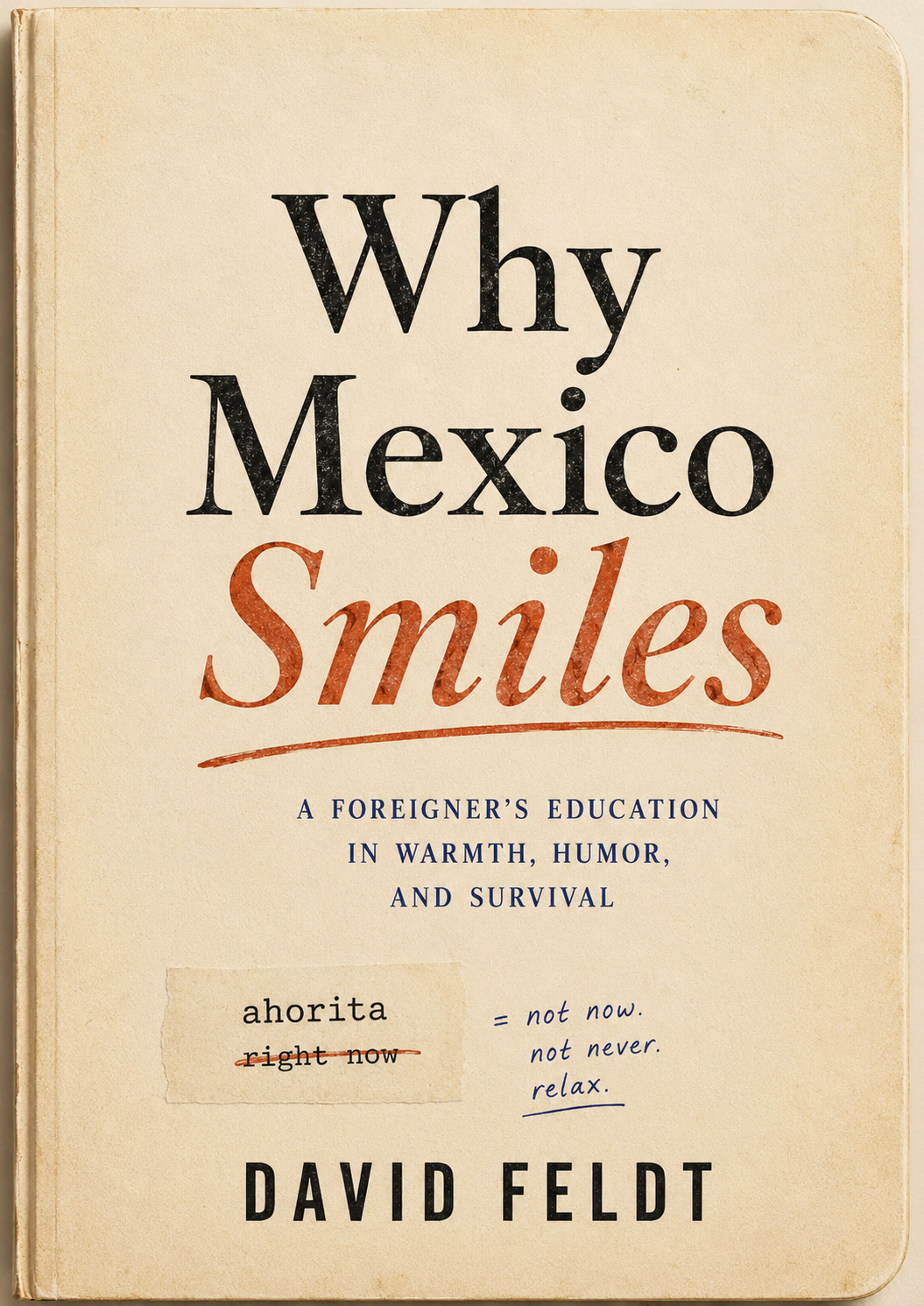
Why Mexico Smiles
A Foreigner's Education in Warmth, Humor, and Survival
A foreigner comes to Mexico to learn a language and instead learns why Mexicans are the way they are. Read Chapter 1 free, or take home the whole thing.

PalabraFlow
Your conversation operating system for Mexico
40 real-life situations, practiced out loud with an AI tutor that talks back in Mexican Spanish and scores how you sound. Stop translating, start answering.