The One Unwritten Rule in Mexico (That Explains All the Others)
If Mexico has one rule that explains everything else, it's not in your guidebook. It's not a law. It's a cultural fear that shapes a thousand small decisions a day.
The phrase is no quedar mal.
Once you see it, you can't unsee it. Every other thing I've written on this site, the soft no, the breakfast portions, the sidewalk dance, the diminutives, the warmth around bodies, is downstream of this single idea.
So here it is. The master rule.
What it literally means
No quedar mal literally translates as "not to come off badly." Or "not to look bad."
In English, those phrases sound vain. They sound like ego. They sound like protecting an image.
That's the first mistranslation that Anglos make. No quedar mal is not about vanity. It is not about the speaker's image. It is about the relationship between two people and what would damage it.
A better translation: "not to harm the bond."
That is not a phrase Spanish dictionaries will give you. But it is what the words mean in lived practice.
What it looks like in daily life
After two years in the Yucatán, here is my running list of moments that no quedar mal governs. None of them feel related on the surface. All of them are.
- A Mexican will say yes to your invitation even when they have no intention of coming. Because saying no would damage the bond.
- A Mexican will overpay a taxi driver they slightly know rather than haggle. Because haggling would damage the bond.
- A Mexican host will refuse to let you pay for your meal even after you both agreed in advance that you would. Because letting you pay, after dining together, would damage the bond.
- A Mexican will tell you the food is delicious even when it isn't. Because saying it isn't would damage the bond.
- A Mexican will agree to a meeting time of "ahorita" rather than commit to a specific hour. Because committing to a specific hour they can't guarantee would damage the bond.
- A Mexican will let an older relative repeat the same story for the fourth time without interrupting. Because interrupting would damage the bond.
- A Mexican will give a long, warm answer to your direct question without ever quite answering it. Because the direct answer might damage the bond.
These are not unrelated quirks. They are the same single mechanic, surfacing in different contexts.
The mechanic is: the bond is more important than the truth, the schedule, the transaction, or my preference.
Why Anglos misread this
In Anglo culture, especially Anglo-American and Anglo-Canadian, the implicit cultural priority is honesty between equals.
You say what you mean. You mean what you say. If you don't show up, you apologize. If you can't pay, you say so. If you hate the food, you don't lie about it, you just don't ask for seconds.
This is a reasonable system, and it has its own beauty. It produces clean transactions. It produces clear schedules. It produces a culture in which you mostly know what's going on.
The trade-off is that the bond has to absorb every small honesty. Every "no, I can't come" leaves a tiny scratch on the relationship. Every "actually, I don't like the food" leaves another. Over decades, those scratches add up.
Mexican culture made a different trade. The bond is protected first. Truth, schedules, transactions are secondary. The result is a culture in which you sometimes don't know what's going on, but the relationships are softer and warmer over decades.
Neither system is correct. They are different operating systems, optimized for different priorities.
If you grew up Anglo and you don't see this, you will spend years furious at Mexicans for "lying" to you, when they were actually being kind in a way you don't have a category for.
The six countries comparison
After 6 cities, here's how I'd rank the cultures I've lived in on the directness-vs-bond-protection axis.
- Berlin / German cultures: Maximum directness. The bond protects itself. Honesty is the gift.
- New York: High directness. Transactional. Bond is built around clear exchanges.
- London: Mid-directness. Bond is protected by understatement and irony, not warmth.
- Toronto: Mid-low directness. Apology is the bond protector. Canadians say sorry instead of warmth.
- Paris: Variable. Direct on big things, indirect on small things. Bond is protected by manners.
- Joburg: High-warmth, mid-directness. Bond is real but you can say hard things.
- Mexico: Maximum bond protection. Directness is sacrificed first. No quedar mal.
If you've come to Mexico from anywhere on the upper half of that list, your social calibration is going to be off for at least a year.
I've been here two years and I still get it wrong about once a week.
The practical takeaway
You don't have to like no quedar mal to live with it. You just have to stop being surprised by it.
When a Mexican says they'll be somewhere at 3 PM, hear: "I will probably be there sometime after 3 PM, but I am committing to the relationship more than to the clock."
When a Mexican says yes to your favor, hear: "I will probably try, but if I can't, you should be reading the soft no in my tone."
When a Mexican says your Spanish is amazing, hear: "I am encouraging you because we have a relationship. The bond is the thing."
When a Mexican host won't let you pay, hear: "This meal is now a gift. Receiving the gift is what makes the relationship work."
You don't have to adopt the system. You just have to translate it correctly.
After two years, I've started to. Sometimes. When I'm paying attention.
The rest of the time, I'm still the Canadian who steps off the curb to let people pass, and apologizes when nobody walked into me, and gets visibly irritated when ahorita turns into Thursday.
The bond, very kindly, is surviving anyway.
30-second version of this is on the channel: The ONE Unwritten Rule in México. Tell me I'm wrong in the comments. I will read every one, slowly, because the bond matters.
The app for real Mexican Spanish: PalabraFlow.
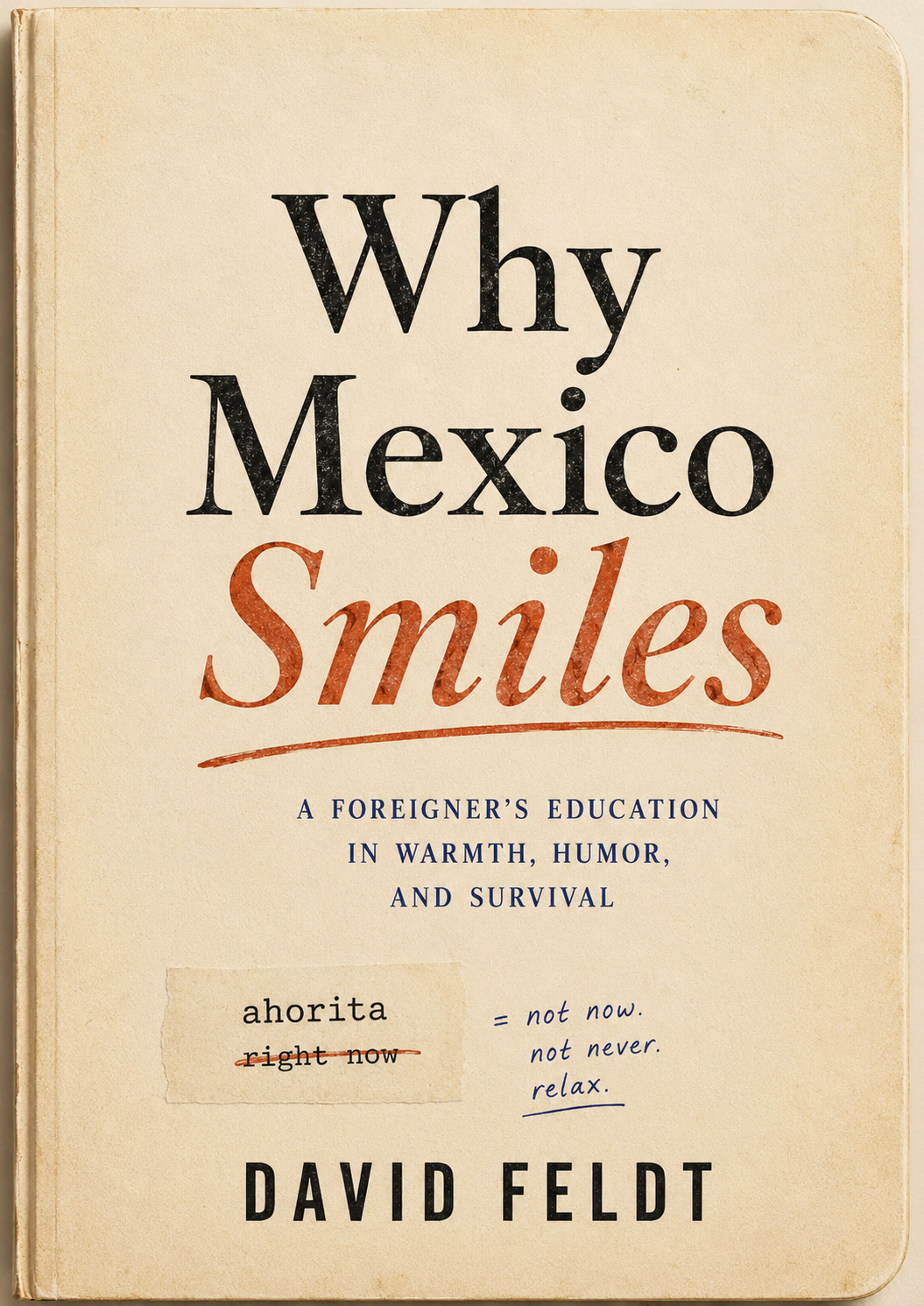
Why Mexico Smiles
A Foreigner's Education in Warmth, Humor, and Survival
A foreigner comes to Mexico to learn a language and instead learns why Mexicans are the way they are. Read Chapter 1 free, or take home the whole thing.

PalabraFlow
Your conversation operating system for Mexico
40 real-life situations, practiced out loud with an AI tutor that talks back in Mexican Spanish and scores how you sound. Stop translating, start answering.