TANTITO: The Mexican Word That Means Whatever the Hell Mexicans Want It To
Most languages have words. Mexican Spanish has tantito.
I've lived in 6 cities and spoken 6 languages badly. None of them prepared me for a single Mexican word that performs the job of, by my count, eleven different English ones.
The textbook lie
If you crack open any Spanish-for-foreigners textbook, tantito is filed somewhere in the diminutives section. The official definition is "a little bit" or "a small amount." The textbook example will be something like:
"Quisiera un tantito de café, por favor." (I would like a little bit of coffee, please.)
The textbook is technically correct. The textbook is missing the entire point.
Real Mexican usage of tantito is not about quantity. It is about softening reality itself.
What it actually does
Here's the field guide. Every example below is something I have personally heard a Mexican say to me with a straight face.
1. Tantito as "a little bit" (the textbook version). "Échale tantito limón." (Add a little lime.) Used. But this is maybe 20% of real usage.
2. Tantito as "just a moment, hang on." "Espérame tantito." (Wait for me a sec.) This is the most common use. Tantito here is not measuring amount. It's measuring time. A very flexible amount of time.
3. Tantito as "barely." "Lo conozco tantito." (I barely know him.) Now the quantity is small, not little. The implication is closer to "almost not at all."
4. Tantito as a hedge against directness. "¿Me prestas tantito tu cargador?" (Can I borrow your charger for a sec?) The tantito here is not asking for a small charger. It's asking for the charger softly, with the implication that you'll give it back fast and you're not putting them out.
5. Tantito as "kind of." "Estoy tantito cansado." (I'm kind of tired.) You're not measuring fatigue. You're flagging it as a soft observation, not a complaint.
6. Tantito as "hold on, I need a second." "Tantito, tantito, déjame pensar." (Hold on, hold on, let me think.) The repetition is doing its own work. The doubled tantito signals real focus or stress without ever having to admit either.
7. Tantito as a way to refuse softly. "Está tantito caro." (It's a little expensive.) Mexican brain translation: I am not paying this. Gringo brain translation: It's slightly above average. Same words. Different worlds.
8. Tantito as flirting. "Acércate tantito." (Come a little closer.) Now tantito is a small physical distance, but the social distance is shrinking faster than the physical one.
9. Tantito as "I'm not done yet." "Tantito y termino." (Give me a sec and I'll be done.) Tantito here is a time word again. The amount is unspecified. Mexican time, of course.
10. Tantito as "almost, but not quite." "Le falta tantito." (It needs just a little more.) Could be cooking. Could be a painting. Could be a song. Could be your conjugation of subjuntivo, which always le falta tantito.
11. Tantito as filler. "Pues… tantito… no sé." (Well… kind of… I don't know.) At this point we've completely left the realm of measurement. Tantito is just a register, a way of slowing the sentence to think.
What's actually going on grammatically
Tantito is the diminutive of tanto (so much, a lot).
In standard Spanish, the diminutive -ito makes things smaller. In Mexican Spanish, the diminutive doesn't shrink. It softens.
The same way gordo (fat) becomes gordito (affectionate). The same way favor (favor) becomes favorcito (a casual gentle ask). The same way ahora (now) becomes ahorita (some flexible Mexican notion of now that may or may not include this week).
Tantito is in this family. The diminutive turns "so much" into a flexible, soft, relational quantity.
The cultural mechanic underneath all of this is the same one that produces the soft no, the long breakfast, and the sidewalk dance. It's no quedar mal. Don't come off badly. Soften the edges. Keep the room warm.
The "ito" family of softening
Once you start seeing this, you see it everywhere.
| Word | Literal | What Mexicans actually mean |
|---|---|---|
| Ahorita | Little now | Sometime between 30 seconds and next Tuesday |
| Tantito | A little bit | Eleven things, none of them about quantity |
| Poquito | A little | Just a touch, but also "barely," "kind of," "softly" |
| Ratito | A little while | Anywhere from minutes to "today, maybe" |
| Tarde-cita | Late-ish | Already late, but I refuse to admit it |
| Fresqui-to | Fresh-ish | Cool, but with affection |
The whole family does the same thing. It softens. It hedges. It keeps the relational temperature warm.
In Anglo English we say what we mean and apologize if it lands too hard. In Mexican Spanish, you say what you mean softly, so it never has to land hard in the first place.
This is a different operating system. Once you see it, you can't unsee it.
What to do with tantito
If you're a Spanish learner and you want to sound less like a textbook, here is the move.
Take any sentence where you'd say "a little" or "a bit" or "sort of" or "please give me a moment" in English. Replace it with tantito. Watch what happens.
Mexican response: a small smile. A barely-perceptible relaxation. They've decided you've spent some time here.
Your textbook will not approve. Your textbook is wrong.
After six countries and one language I'm finally taking seriously, here is the move I trust most: when in doubt, soften with a diminutive. Tantito is the gateway. From there you discover poquito, ratito, ahorita, and the whole architecture of warm refusal that the Mexican language was built around.
A language is not a list of words. It is a posture toward the people in front of you.
Tantito is the posture.
30-second version of this is on the channel: One Word Mexicans Use for EVERYTHING: TANTITO. Tell me I'm wrong in the comments.
Want all the Mexican diminutives in one place? Try PalabraFlow. The app for real Mexican Spanish.
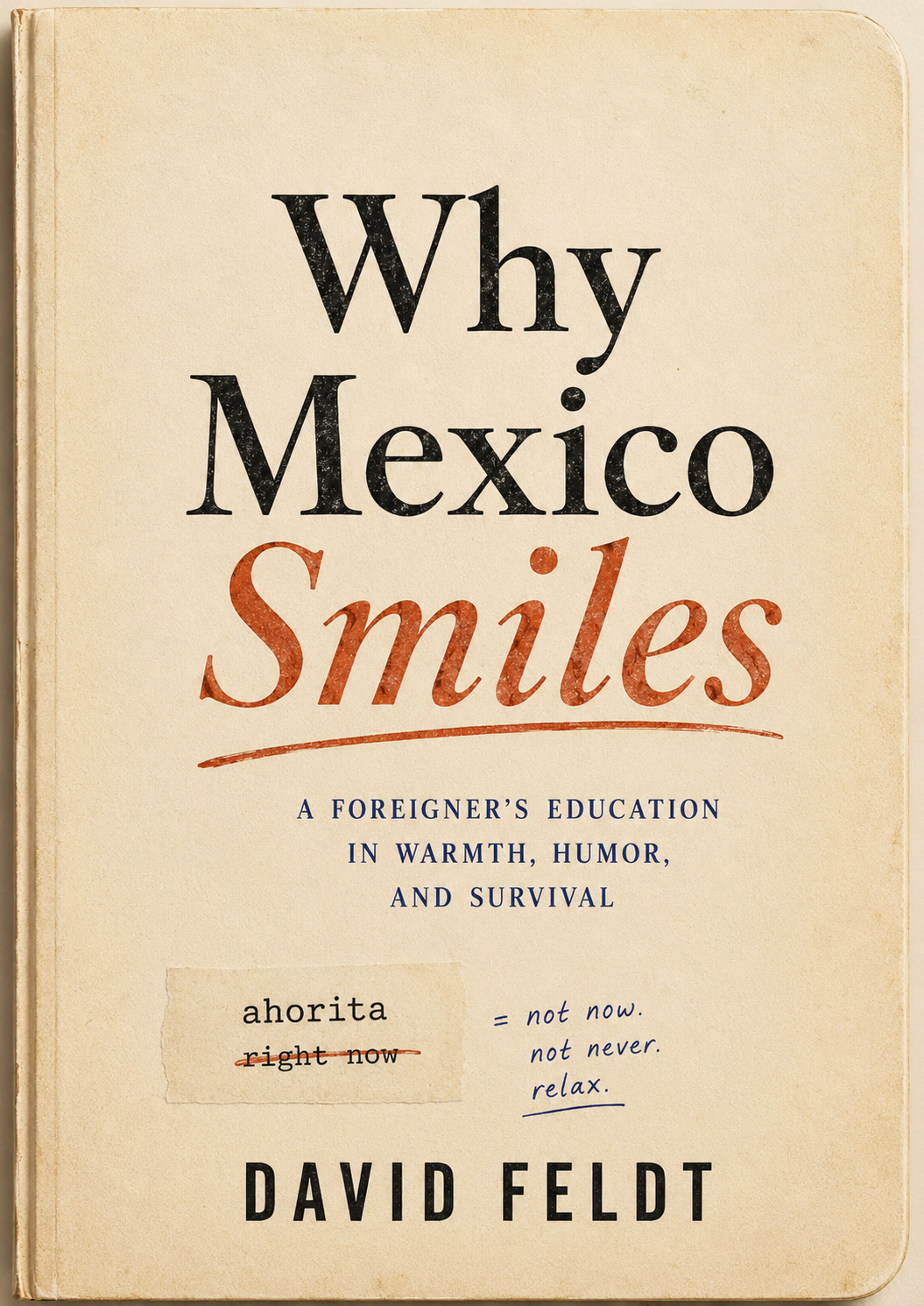
Why Mexico Smiles
A Foreigner's Education in Warmth, Humor, and Survival
A foreigner comes to Mexico to learn a language and instead learns why Mexicans are the way they are. Read Chapter 1 free, or take home the whole thing.

PalabraFlow
Your conversation operating system for Mexico
40 real-life situations, practiced out loud with an AI tutor that talks back in Mexican Spanish and scores how you sound. Stop translating, start answering.