Mexico's Unwritten Sidewalk Rule (And the Six More Nobody Tells You)
I lived in 6 cities before Mexico.
In London, I learned to apologize when someone walked into me. In Toronto, I learned to apologize even when nobody walked into anyone. In New York, I learned to use my left shoulder as a weapon. In Paris, I learned that the sidewalk is mine if I commit. In Joburg, I learned to keep my head up.
None of them prepared me for Mexico.
The first sidewalk problem
In my second week in Mérida, I was walking down a narrow sidewalk in the Centro. Coming the other direction: an older man, walking slowly, fully on the sidewalk, with no apparent intention of moving.
I stopped. I stepped sideways, off the curb, into the street, to let him pass.
He didn't acknowledge it. He didn't say gracias. He just walked through the space I'd vacated.
I felt simultaneously like a gentleman and like an idiot.
A month later I figured out: I had behaved like a Canadian. He had behaved like a Mexican. We had not been playing the same game.
The actual rule
Here's the rule I eventually pieced together, after months of getting it slightly wrong.
In Mexico (and the Yucatán in particular), the sidewalk is shared, but the dance is asymmetric. The asymmetry is hierarchical, not random.
- The older person gets the inside lane (away from the street).
- The woman gets the inside lane, especially in older Centro neighborhoods.
- The family with kids gets the whole sidewalk, and you step around them.
- The person carrying something gets the right of way, almost universally.
- The person walking with purpose outranks the person paseando (strolling).
- The person who got there first gets the next half-second of clearance.
If none of these apply, the negotiation happens silently. Someone shifts. Someone slows. Almost nobody apologizes, because apology would imply that someone was at fault. And nobody was.
This is the cultural mechanic underneath: the sidewalk is a relational space, not a transactional one.
In Canada, walking is a series of small transactions. I yield. You acknowledge. We're square. If the acknowledgment doesn't come, the transaction feels broken. The Canadian feels mildly betrayed.
In Mexico, walking is a series of small social arrangements. There's no transaction. There's no debt. You moved. They didn't. Nothing happened. Nothing needs to be settled.
The six other rules
Once I noticed the underlying pattern, the other rules started clicking into place.
1. Don't step into the street to let people pass. This is the gringo move. It marks you as a foreigner immediately. The Mexican move is to slow, or turn your shoulder, or pause for half a second. You stay on the sidewalk.
2. Don't say "perdón" if you didn't actually do anything. Anglo brains apologize as social lubricant. In Mexico, perdón implies fault. If nobody is at fault, nobody apologizes. You'll get a confused look if you over-apologize.
3. Greet people you pass closely, if your eyes meet. "Buenos días" or "buenas tardes" at the right moment is correct. This is especially true in smaller neighborhoods, towns, or the Centro of any city. The greeting is the social transaction, not the yielding.
4. Don't walk three-abreast on a narrow sidewalk. Locals know to split into pairs or singles. Tourists do not. This is one of the easiest gringo tells. You don't own the sidewalk because you're with friends.
5. The señora with the shopping bag has total right-of-way. No exceptions. She is doing her mandado. You yield. You step aside. You smile and say "buenas." If you don't, you are, technically, a barbarian.
6. Dogs on leashes get respect. A leashed dog and its person are a single moving unit. You go around. You do not pat the dog without asking. The dog's person will appreciate this more than the dog does.
Why none of this is in a guidebook
Because guidebooks treat culture as a list of facts.
Sidewalk etiquette is not a fact. It's a posture.
You can't memorize it the way you can memorize how to ask for the bathroom. You absorb it by watching, by getting it wrong a few times, and by paying attention to who gets visibly annoyed when you do.
Mexican social space is full of rules that no one will ever write down for you, because no one ever needed them written down. They learned them as children.
If you're a foreigner, your job is to watch.
What it means in practice
The hardest thing for a Canadian or American to internalize is the no-acknowledgment-required part. When you yield to a Mexican, they will often not say thank you. When a Mexican yields to you, you should often not say thank you either.
The yielding is the communication. The thanking is the foreign overlay.
After two years, I still get this wrong. I still mumble "gracias" to the older man who stepped aside to let me pass. He still looks at me like I've handed him a coupon.
But I've stopped stepping into the street.
And I've started, slowly, to walk like someone who lives here.
Six countries in. The sidewalk is still teaching me things.
30-second version of this is on the channel: Mexico Forced Me Onto the Sidewalk… Big Mistake. Tell me I'm wrong in the comments. Especially if you live in Mexico City, where the dynamics are a little different.
The app for real Mexican Spanish: PalabraFlow.
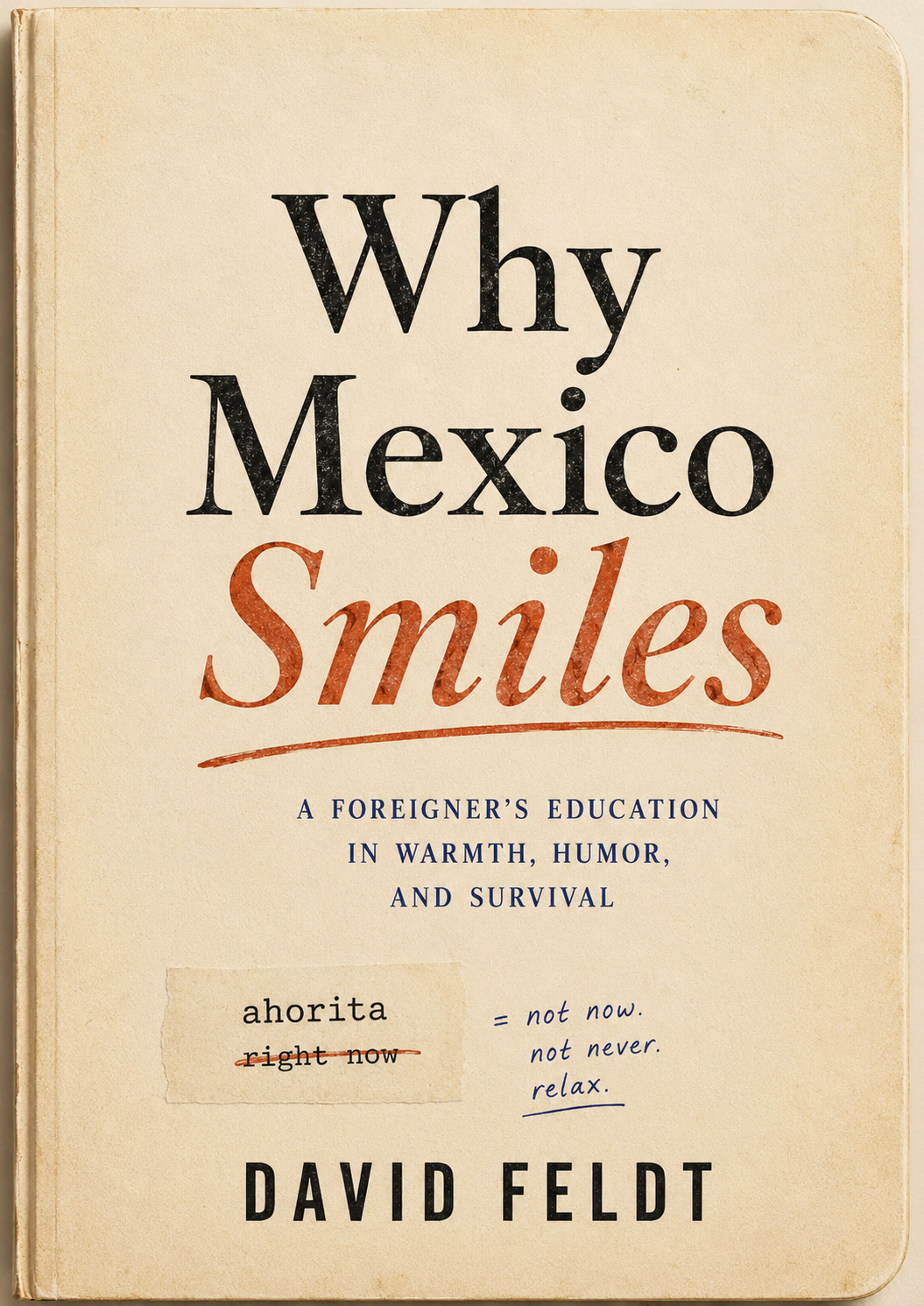
Why Mexico Smiles
A Foreigner's Education in Warmth, Humor, and Survival
A foreigner comes to Mexico to learn a language and instead learns why Mexicans are the way they are. Read Chapter 1 free, or take home the whole thing.

PalabraFlow
Your conversation operating system for Mexico
40 real-life situations, practiced out loud with an AI tutor that talks back in Mexican Spanish and scores how you sound. Stop translating, start answering.