How to Tell If You're a Gringo in Mexico (The 10 Tells)
Mexicans can spot a gringo from fifty meters. There are ten tells. I have personally exhibited eight of them. Here are all ten, in order of how visible they are.
This list is humiliating. It is also, in two years, the most useful self-audit I've done. If you're moving to Mexico, traveling here, or just visiting for a long weekend, run through it. Subtract one point of gringo-visibility for every one you can honestly say you don't do.
I scored a 2 out of 10 my first month. I'm at 7 today. I'm aiming for 9.
1. You wear shorts in non-recreational contexts.
The biggest visual giveaway. I wrote a whole post about it but the short version: Mexican adults wear long pants almost everywhere. Restaurants, businesses, the Centro, family events. Shorts are for the beach, soccer, and home. If you're in cargo shorts at a 2 PM lunch, you might as well be holding a flag.
2. You say perdón when nobody walked into anyone.
Anglo brains apologize as social lubricant. Mexicans don't. Perdón in Mexican Spanish implies fault. If nobody was at fault, the apology is awkward. It forces the other person to disagree with you, which is, ironically, an Anglo move.
The Mexican equivalent of the Canadian "sorry" is a slight smile and a small nod. No words. The communication is in the body.
3. You stand too far away when speaking.
The standard conversational distance in Anglo cultures is about 80 centimeters. In Mexico, it's closer to 50. To a Mexican, the Anglo distance reads as cold. To an Anglo, the Mexican distance reads as crowding.
When a Mexican steps slightly toward you in conversation, do not step back. That's a gringo move. Hold the space. Even if it feels close. Especially if it feels close.
After two years, I still occasionally retreat. The Canadian wiring is deep.
4. You don't greet the room when you enter.
Walking into a small store, a café, an office, or a waiting room without saying "buenos días" or "buenas tardes" is a clear tell. Mexicans greet the room. Even strangers. Even briefly. The greeting is the opening of the social space.
Anglos walk in silently and proceed to their task. Mexicans pause, greet, then proceed. The pause is 1.2 seconds. It is socially mandatory.
5. You over-tip in some places and under-tip in others.
The Anglo tipping muscle is calibrated for American restaurants (20%) and confused about everywhere else. So gringos in Mexico tip 25% at a restaurant (over) and forget to tip the grocery bagger at all (under).
The Mexican calibration:
- Restaurant server: 10-15%, depending on the place.
- Hotel housekeeping: 30 to 50 pesos per night, in cash on the bedside.
- Grocery bagger: 5 pesos. Always.
- Taxi driver: usually nothing, unless they helped with bags.
- Ayudante who walked you to a parking spot or held it for you: 10 pesos.
- Gas station attendant who filled your tank: 5 to 10 pesos.
Mexicans tip more roles, smaller amounts, more often. Gringos tip fewer roles, larger amounts, awkwardly.
6. You ask for things by saying "quiero" (I want).
The Anglo way to ask for things is direct: "I want X." The Mexican way is relational: "Me regala X" (gift me X), "¿Me da X?" (would you give me X?), or "¿Me pone X?" (would you put on X?).
Quiero sounds demanding. It works, but it marks you. Switch to me regala and watch the energy of the vendor shift.
7. You don't know which buenas to use, so you default to hola.
Hola is technically the Spanish word for hello. It is also rarely the most appropriate Mexican greeting in a real social context. The Mexican defaults are:
- Buenos días morning, before noon.
- Buenas tardes afternoon, until ~7 PM.
- Buenas noches evening, after dark.
Or, the casual contraction Mexicans actually use:
- Buenas short for any of the above. Used by people who live here.
Hola sounds, to a Mexican ear, like "hi" sounds to a British ear. It's a children's word, technically correct but socially flat.
8. You ask for agua without specifying natural or de sabor.
In Mexico, when you ask for agua, you have to specify agua natural (water) or agua de [sabor] (flavored water, like agua de jamaica or de horchata). Otherwise the server will hesitate.
Anglos default to thinking agua = water. Mexicans default to thinking agua = drink option that needs clarification.
The fix is easy: "¿Tiene agua natural?" or "¿Qué aguas tienen?" Either works.
9. You ask if the chilaquiles can come without the eggs and cream.
This is the breakfast version of the cargo-shorts tell.
Mexican food, especially breakfast, is a gestalt. The chilaquiles come with the eggs, the cream, the cheese, the salsa, the beans on the side. Asking to disassemble the dish is asking the cook to dismantle the meal.
The Mexican move is to eat what's served. The dish was assembled by someone who knows what they're doing. Trust it. Or order something different.
10. You over-explain why you can't do something.
This one is the deepest. Anglos, especially Canadians, over-explain refusals. "Oh I would love to come to the party but actually that's the day my brother is in town and we had already planned…"
Mexicans don't do this. A Mexican refusal is "déjame ver, te aviso" or "sí, claro, ahorita lo vemos." Three words. No paragraph of justification.
When you over-explain, you accidentally signal: "I do not trust you to read between the lines, so I am giving you a complete defense of my refusal." This reads, to a Mexican, as slightly distrustful of the relationship.
After two years here, I have started, very slowly, to refuse things in three words instead of a paragraph. It is the single most-Mexican habit I have picked up. My Canadian friends have started commenting on it. They think I've become rude.
I have not become rude. I have become Mexican-influenced. Which, in Anglo culture, is the same thing.
Your score
If you scored 0-3: you've been here a while or you're a natural mimic.
4-6: normal range for someone in their first year.
7-10: you arrived last week. Welcome. The shorts are the first thing to fix.
I'm at 7 of 10 right now, which is honestly higher than I'd hoped. I'm working on it.
The point is not to stop being a gringo. You're a gringo. That's fine. The point is to be the kind of gringo Mexicans like.
The kind of gringo Mexicans like is the kind who notices.
30-second version is on the channel: How to Tell if You're a Gringo in México. Comment your own gringo confession. I'll read every one.
The app for real Mexican Spanish: PalabraFlow.
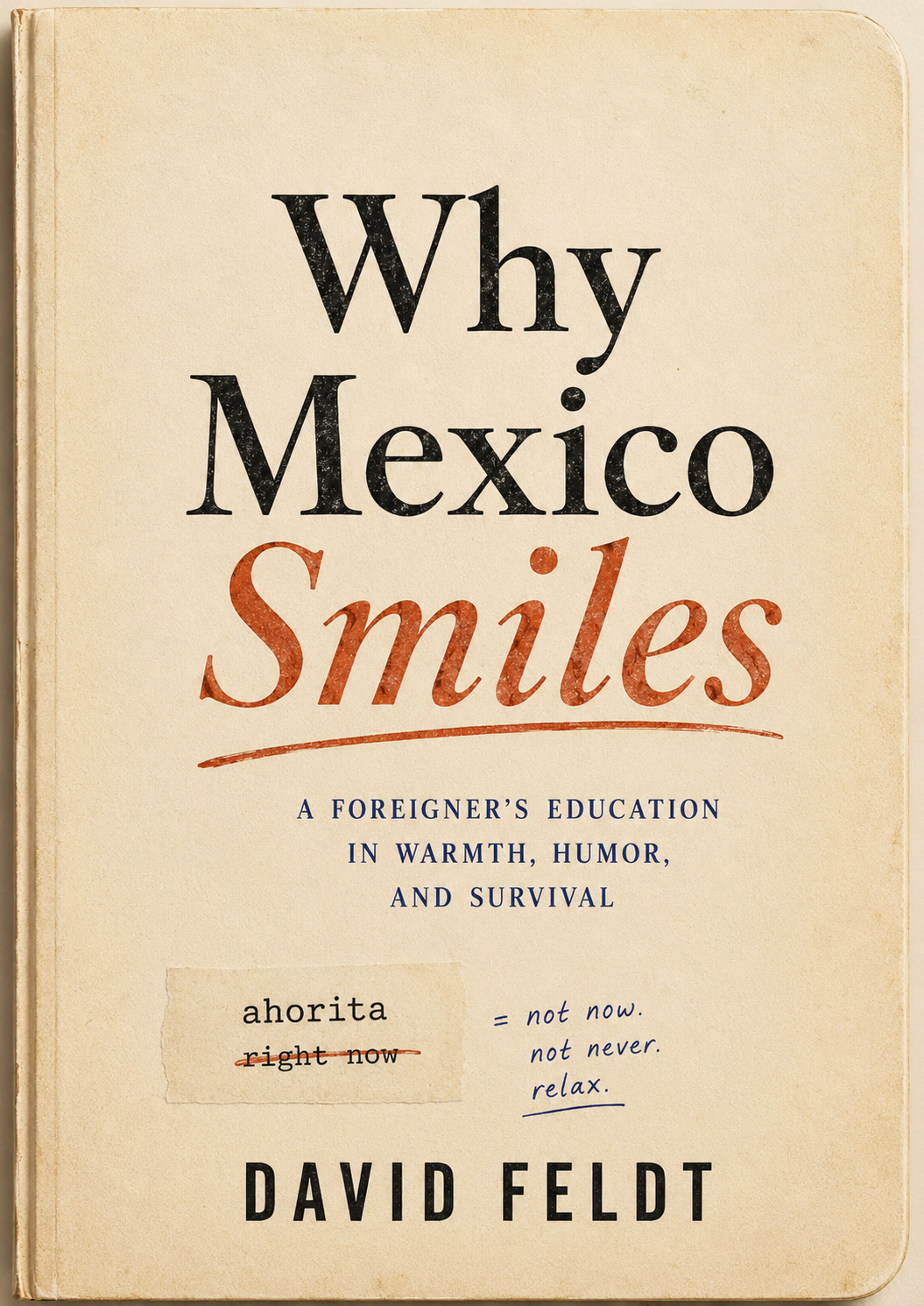
Why Mexico Smiles
A Foreigner's Education in Warmth, Humor, and Survival
A foreigner comes to Mexico to learn a language and instead learns why Mexicans are the way they are. Read Chapter 1 free, or take home the whole thing.

PalabraFlow
Your conversation operating system for Mexico
40 real-life situations, practiced out loud with an AI tutor that talks back in Mexican Spanish and scores how you sound. Stop translating, start answering.