How Mexicans Actually Order Tacos (I Was Doing It Wrong for Nine Months)
I asked for tacos in Mexico for nine months before I realized I'd been ordering them like a tourist the entire time.
The vendor never said anything. Mexican vendors don't say anything. They just give you a small, soft smile and hand you the food.
Then one evening in a tianguis in Mérida, a Mexican friend ordered for both of us, and I watched the difference. Different words. Different rhythm. Different vendor energy. Same tacos.
That's when I understood I'd been speaking Spanish-class Spanish in a Mexican-Spanish world.
What Spanish class taught me
The textbook way to order tacos:
"Quiero tacos, por favor."
Translation: "I want tacos, please."
This is technically perfect. Grammatically flawless. Polite. And it marks you as a foreigner from twenty feet away.
I used some version of this sentence at every taco stand for nine months. Sometimes I dressed it up: "Quisiera tres tacos, por favor." Sometimes I went generic: "Me da unos tacos." Sometimes I went desperate: "Tacos, por favor."
Every version of this sentence said the same thing to the vendor: "I am visiting your country and I learned Spanish from a book."
What Mexicans actually say
Here is the rhythm. I learned it from watching for a year.
Step 1: The greeting
You walk up. You make eye contact with the vendor. You say:
"Buenas."
Just "buenas." Not "buenos días." Not "hola." The short version. It's local. It marks you as someone who's done this before.
The vendor will say "buenas" back, or "qué onda," or "¿qué le doy?" (what'll I give you).
Step 2: The order itself
Here are the three Mexican-native phrasings, in increasing order of fluency.
Beginner: "Me regala tres pastores con todo." Literally: "Gift me three pastors with everything."
The construction "me regala" (you gift me) is the polite Mexican way to ask for things from a vendor. It's softer than "me da" (give me) and lightyears better than "quiero" (I want). The verb implies the transaction is a small gift, not a demand.
Intermediate: "¿Me pone tres pastores, jefe? Con todo." Literally: "Can you put on three pastors for me, boss? With everything."
"Jefe" (boss) is the Mexican vendor honorific. It signals respect for the person behind the counter. "Me pone" (you put on) is the cooking-context verb, used when food is being assembled.
Local: "Va a ser de tres pastores con todo, jefe. Y un agua de jamaica." Literally: "It's going to be three pastors with everything, boss. And a hibiscus water."
The phrase "va a ser" (it's going to be) is the most-Mexican way to start an order. You're not asking. You're not demanding. You're describing what the order is going to be, as if it's a fact you've both already agreed on.
Step 3: The followup
When the vendor hands you the first taco, you say:
"Gracias, jefe."
Not "muchísimas gracias." Not "gracias por todo." Just gracias, jefe. Then you eat.
When you're done and paying:
"¿Cuánto le debo?"
Literally: "How much do I owe you?" The verb deber (to owe) is the Mexican move here. "¿Cuánto es?" (how much is it?) works but feels transactional. "¿Cuánto le debo?" implies relationship.
The one word that fixes everything: antojo
The deepest Mexican move at a taco stand is to describe your hunger using the word antojo.
Antojo means "craving." But it's not just a noun. In Mexican Spanish it's a whole register.
"Se me antojan unos tacos." (I'm craving some tacos. Literally: tacos are craving themselves to me.)
This sentence is the unlock. Se me antoja uses a reflexive construction that puts the food, not the eater, in the active position. The grammar moves you out of the way. You're not the demanding customer. You're a person whose body is reporting a craving.
It is the most relationship-oriented way to ask for food in any language I have ever encountered.
Try it once. Walk up to a taco stand. Make eye contact. Say:
"Se me antojan unos al pastor, jefe."
The vendor will smile. Not the soft polite tourist-smile. The other one. The one that means you've been let in.
Why this matters
After six countries, I've learned that food vocabulary is the fastest way to tell who's a tourist and who lives somewhere.
In London, ordering "a coffee" without specifying flat white or americano marks you. In Paris, asking for "un café" without context marks you. In New York, hesitating at the deli counter for more than 1.2 seconds marks you. In every city I've lived in, the food-order rhythm is the giveaway.
In Mexico, the giveaway is quiero.
It's not wrong. It's just foreign.
The Mexican alternative, se me antoja, me regala, va a ser de, jefe, is the same order. Different posture. The posture is the thing.
The posture is everything I've been writing about on this channel. Mexican Spanish prefers warmth to efficiency. Relationship to transaction. Soft over direct.
The taco stand is just the easiest place to practice it.
30-second version of this is on the channel: How Mexicans REALLY Say "I Want Tacos". I'm still bad at 6 languages, but I have, finally, gotten good at ordering tacos.
The app for real Mexican Spanish: PalabraFlow.
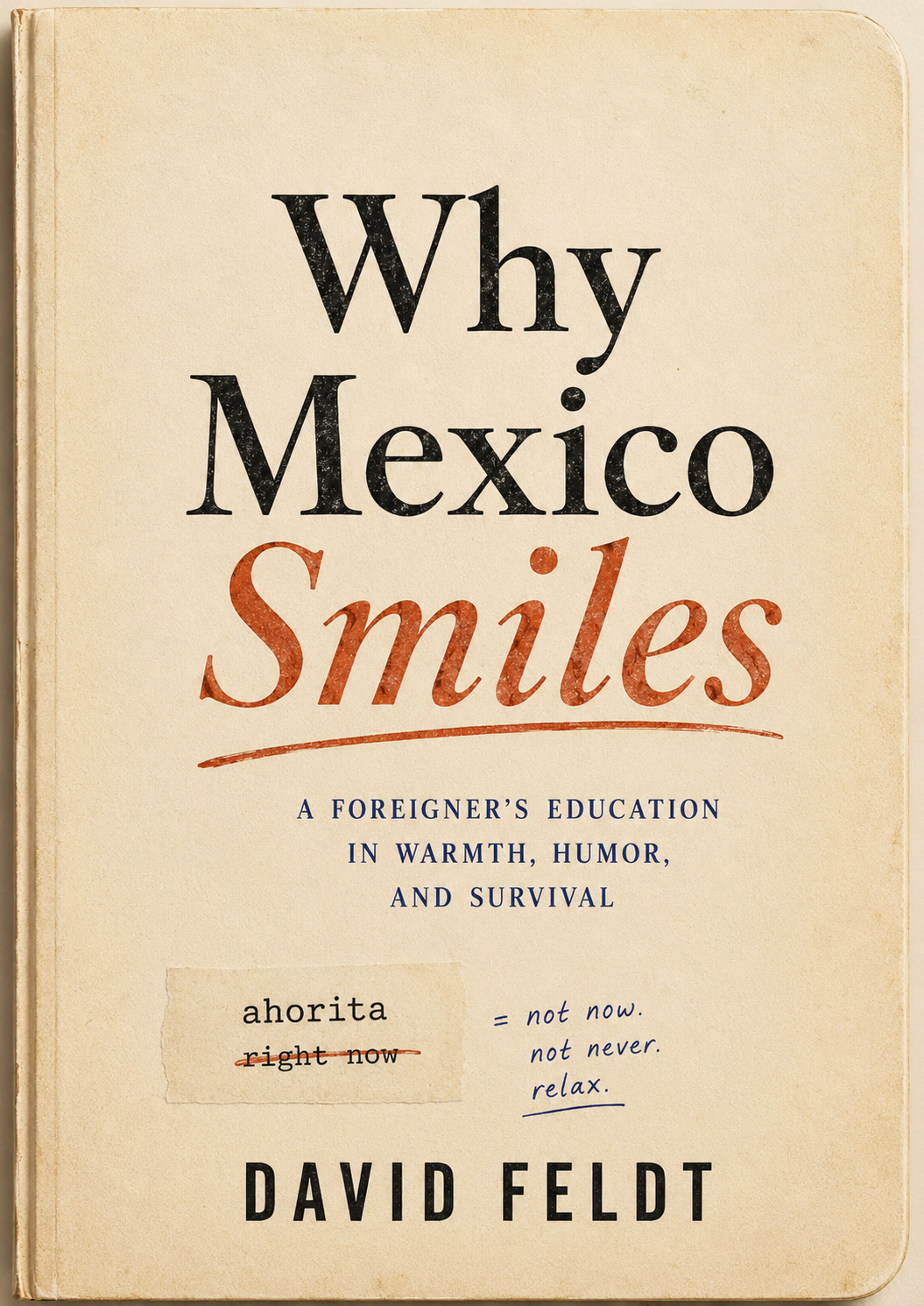
Why Mexico Smiles
A Foreigner's Education in Warmth, Humor, and Survival
A foreigner comes to Mexico to learn a language and instead learns why Mexicans are the way they are. Read Chapter 1 free, or take home the whole thing.

PalabraFlow
Your conversation operating system for Mexico
40 real-life situations, practiced out loud with an AI tutor that talks back in Mexican Spanish and scores how you sound. Stop translating, start answering.